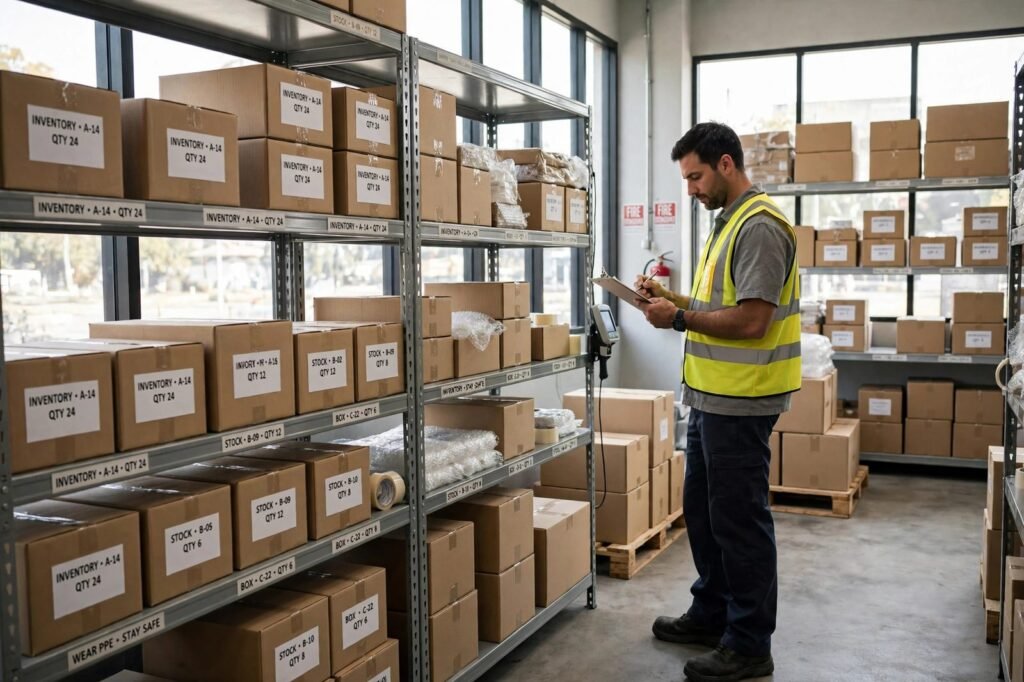
Inventory appears on almost every balance sheet, and it confuses people like the word sounds like it means “everything a business owns.” Not. If you ask me what inventory is in business, the answer would be much more narrow and more useful: inventory is what an enterprise must sell for sale or use to produce what it sells.
That purpose test decides everything. The same item can be inventoried for one business instead of the other. Test is the goal of the item, not the item itself.
What Is Inventory in a Business
Inventory is a current account of balance sheet assets, comprising all raw materials, works and final finished products that are stored by the company. It is often the most illiquid in all current assets and is therefore excluded from the numerator when calculating a rapid ratio. A company cannot pay a bill with unsold stock with cash as fast as possible.
The purpose test draws the line. Because the flour is the bread that’s going to be sold, the flour in the bakery is the stock. The ovens at the bakery are not inventory because they are used to work, not sold.
A dealer’s car is inventory. The dealer’s showroom is not. Equipment, vehicles and buildings that are used are assets, but they are not inventory because they are not kept for sale.
The Four Types by Production Stage
After the production process, the inventory falls into four types. Raw materials are basic materials in which work has not yet started: steel for an automobile manufacturer, cotton for a towel manufacturer. They are directly associated with the finished product.
Components are parts that stay recognisable after installation: a screw, a computer chip, a lamp. They are quite different than raw materials by retaining their identity in the finished product.
The pending works represent stocks that have entered the proceedings but have not yet been completed: half-assembly units seated on the floor of the plant at the current time. The total cost of Finished goods is fully available for sale and costs include raw material costs, direct work and overhead costs.
Production is being promoted in the fifth category, without becoming part of the production. MRO supplies, just for maintenance, repairs and operation, are machine lubricants, cleaning, printer toner, and paper. They keep the business going, but they never end up in the customers’ purchases.
What Counts Depends on the Business
The same shelf looks different from one company to another. A retailer or distributor keeps merchandise purchased for resale: finished goods bought from someone else, waiting for a customer. So it’s an actual manufacturer that keeps all four types, from raw material to finished goods, because he does something that sells.
That’s an interesting case for service-business. The company has the supplies it uses or sells but does not have the time or unused capacity. The bottles of detergent from a cleaning company are inventory.
It’s not that clock the cleaners haven’t had any work already. The purpose test deals with all three cases in the same way: held for sale, or used to make what is sold counts.
Inventory vs Stock
It is the same stock and inventory in bookkeeping, and the words are scattered when used on a daily basis. People typically say “stock”, when they mean finished goods, ready to be sold in a shelf or warehouse, and they say “inventory” for the whole picture, including raw materials and ongoing work.
There’s a difference that matters mainly in talk. There is one account in the financial statements, which covers anything that is likely to be sold or processed into something that is sold. When a supplier or lender says “stock,”, they typically mean the finished portion of the product so it is worth to ask which portion you mean.
From Inventory to Cost of Goods Sold
On the balance sheet, the inventory is not retained forever. Where the goods are sold, the cost shall be included in the income statement as the value of goods sold. The formula links these two factors: the completion of the inventory corresponds to the start balance plus purchase minus goods sold.
This formula also consists of how the company checks its own number. When sales are known to be sold and purchased, there must be an end balance. If not, then there is something wrong – goods lost, damaged, stolen or miscounted.
Four methods of calculating costs determine what costs will be incurred first. FIFO, first in, first of these implies the oldest goods sell first. LIFO, last in, first out, will take the latest sell first.
Weighted average blends costs together. Specific identifications track actual costs for each item. LIFO costs a greater number of costs for goods sold and a smaller inventory balance sheet than FIFO, since the newer pricier goods is counted as a first sales figure for one inflationary period.
For one sole owner are the costs of goods sold Part III from Schedule C. Our guide to Schedule C basics for the self-employed walks through that form line by line.
Periodic vs Perpetual Systems
Companies track inventory through one of the two systems. The periodic system determines inventory values at the end of each period by counting the remaining stocks. A perpetual system updates the value after each transaction, meaning the balance is current at any time.
The choice changes the numbers. Given that costs vary over time, there may be different values for periodical counts and record-keeping and analysts comparing the two companies need to consider this difference. Small firms often start their operations periodically by counting at the end of the month or year and moving continually towards increasing volume and achieving real-time accuracy.
A dated example of an enterprise displays the scale. In 2022 fiscal year Procter and Gamble announced materials and shipments of about 2.2 billion dollars, work in process of $856 million, and finished goods of 3.9 billion dollars. These figures are 2022 but their shape is typical: The made of-goods are usually dominant as all pre-spent costs are collected.
Frequently Asked Questions
What is business inventory?
The goods that were used by the business are sold or used to manufacture what they sell. This is the current asset in balance sheet, which covers raw materials, ongoing work and finished goods.
Which types of inventory?
Goods, components, up to date work and finished goods, plus MRO, which supports production without being part of the product.
Is inventory an asset?
Yes, a current asset. Often it is the most illiquid current asset, therefore, it is excluded from the fast ratio.
What is the difference between stock and inventory?
They’re the same in accounting. When used on a daily basis, stock usually means finished goods ready to sell, while inventory covers anything that is available for sale or production of what is sold.
How does the cost of inventories become goods sold?
When the goods are sold, the costs are transferred from balance sheet to the statement of income. The end of the inventory is equal to the initial balance plus purchases minus goods sold cost.
This Article is solely intended for educational purposes and does not constitute legal or tax assistance. Share accounting and tax treatment will depend on your company and jurisdiction so you can speak to a qualified expert yourself.