Someone you know needs help on medical bills, a community project needs financial assistance, or a charity wants to contact new donors. The answer that keeps coming back is crowdfunding, but not all crowdfunding works the same way. Donation-Based Crowdfunding is the version in which people give money and expect nothing back, and every single fact is all about it.
What Donation-Based Crowdfunding Is
Donation-Based Crowdfunding means people give money for a purpose without waiting for it. It fits personal needs, the interests of the community and charity, and a donor’s reward means help, not goods, split or fixed.
That’s different from the other three types. Rewards-based crowdfunding gives backers a product or perk in return, the model which is used by Kickstarter and Indiegogo. Equity-based crowdfunding gives backers an investment in the company.
Debt-based crowdfunding is a loan which has to be repaid. Only the donation model matches a personal need because there is nothing to sell or a company to own some of it.
Donation crowdfunding is also not a loan, and there is no repayment or interest, as opposed to a business loan. Comparing financing pathways for a business, our small business loan guide will cover what lenders check before lending. However, donation crowdfunding often is the easier fit for a personal or community cause.
The Three Steps
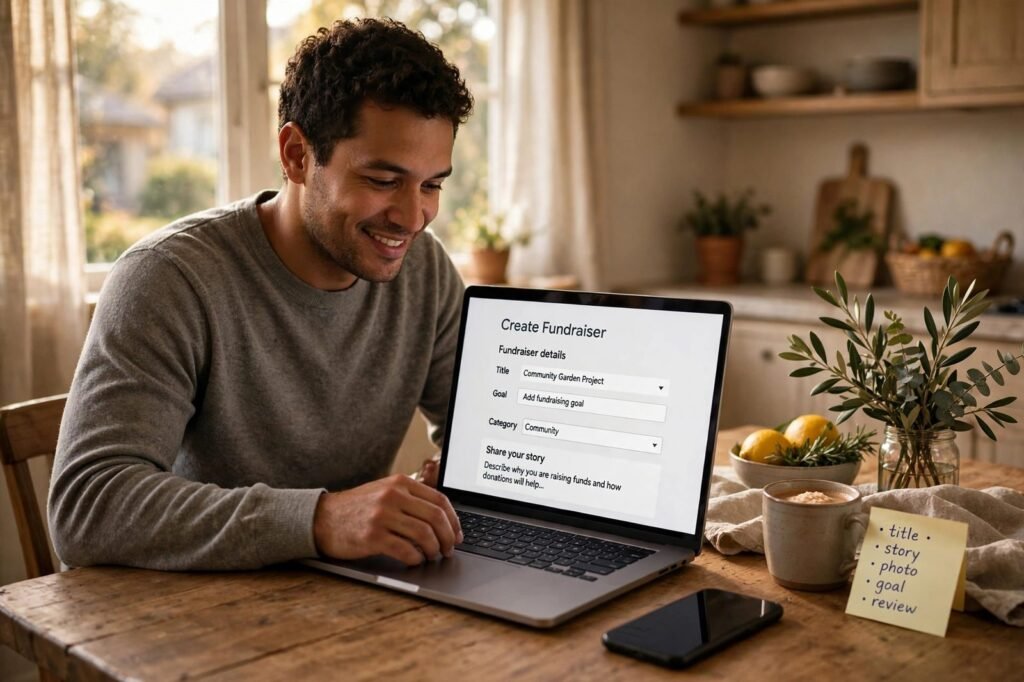
GoFundMe, the best known basis for donations, describes three stages of the process. Its shape is the same for most platforms. Do a fundraiser first, put a goal, tell your story and add a team to help when others help. Second, the exchange: social media, e-mails and text messages are the way most donors find the fundraising campaign. Thirdly, accept donations, add banking information, and add beneficiaries if you raise money for another.
GoFundMe only allows for donation-based crowdfunding, and no fixed fundraising timeline on the platform. Likewise, there is no application procedure as part of the appeal: you can quickly organize a donation campaign and start generating money quickly. That speed comes with a trade-off, outlined below: Nobody is promoting your fundraising efforts.
What It Costs, on a Real Example
It is free to launch and manage a donations campaign on GoFundMe, but the initiation is not free to receive. Every gift is subject to a fee per donation.
The platform’s own Help Center offers an example of US: A $50 donation leaves the recipient with 48.25 Dollar at a 2.9 percent and 0.30 Dollar fee. Returning donations pay a higher 5 percent fee per donation. Donor tips are optional, can be converted to $0 by the donor, and the organizer can not see who tipped. The fees are shown below Transfers, then Breakdown, so you can look out for exactly what was taken with every donation.
Two warnings belong here. First, these are the figures for GoFundMe and not universal rates. The other platforms charge differently, so check the fee page for each platform that you use. Second, fees decrease the amount of resources received that counts when you reach your goal: When you need 5,000 dollars in hand you must raise more than 5,000 dollars in donations.
Why Fundraisers Fail
The same reason why most fundraising failures fail is that nobody has heard of them. With the organiser, the promotional burden is entirely. A fundraiser with a good story but no parts only reaches the nearest circle of the organizer, and that circle is usually smaller than the purpose implies.
There is no secure goal either. The fund-raising could end below the target, and the funds were still being raised and the shortfall needed to be covered in some way. Confidence and security checks add another layer: Platforms carry out verifications and Giving Guarantee, and fundraising activities that look obscure or inconsistent can be stopped during these checks.
Updates are what most organisers skip, and that costs more than people notice. A fundraiser that seems silenced after the launch seems to be abandoned, even if the need is still real. Short updates, a thank you to the early donors. A note when the money is spent, all signal that the cause is alive and the organizer notices. Donors feeling well informed will share the connection much more frequently, and the second part often extends to those who have never touched the former.
Truth is, crowdfunding is a distribution job and it’s not just a story-job. The story is important, but more important is the sharing plan.
The Questions to Ask Before You Launch
Before launching, ask three questions. First of all, what are your legal obligations? The rules for fundraising vary, and a fundraiser for somebody else adds beneficiary and banking questions that need to be sorted for initial donation, does not.
Second, what tax questions? The tax treatment of donations depends on the situation, recipient and purpose. No FAQ platform can answer them in your case. Talk to a tax specialist instead of relying online on general claims.
Third, is your goal genuine and transparent? One clear objective, concrete use of money and regular updates contribute to trust that ad hoc donors would become Sharers. Vague goals do the opposite.
Frequently Asked Questions
What is donation-based crowdfunding?
It is fundraising, where people give money without expecting anything in return for personal needs, communities and non-profit organizations.
So, how’s it different from reward crowdfunding and stock crowdfunding?
Rewards backers receive a product or bonus. Equity backers receive shares in the company. Donation backers receive nothing but the knowledge they helped.
How do I start the fundraiser, and how much did that cost?
Make a fundraiser with purpose and history, share them and accept donations. Starting is free of charge on GoFundMe, but every donation will incur a transaction fee, e.g.2.9 percent plus 0.30 dollars to a $50 US donation which will make 48.25 $.
Do donors get anything back?
No, donors expect nothing in return for donation-based crowdfunding. And that’s the key characteristic of the model.
What are the risks and taxes?
The main risks are the burden of promotion, the lack of assured objectives and the verification of trust on the platform. Tax treatment depends on your situation, so just ask a tax professional.
This Article is not legal or tax advice and is exclusively for educational purposes. Funds Acquisition Rules, Platform Cost and Tax Treatment vary depending on platform and situation, so check the current conditions of the platform and talk to a qualified professional about your own fundraising.