You deposit a check. Your banking app will show you the cash within a day. You spend some of it.
The deposit returns a week later, and your account will be overstated. This is the most misunderstood moment of everyday banking business, and it has a name: check verification. Understanding check verification means understanding that awkward truth.
The money your bank is showing you doesn’t always represent money it’s done checking out. The Guide follows a filed check from the counter to final settlement, and explains where the trap is located.
Check Verification Begins: What Happens the Moment You Deposit
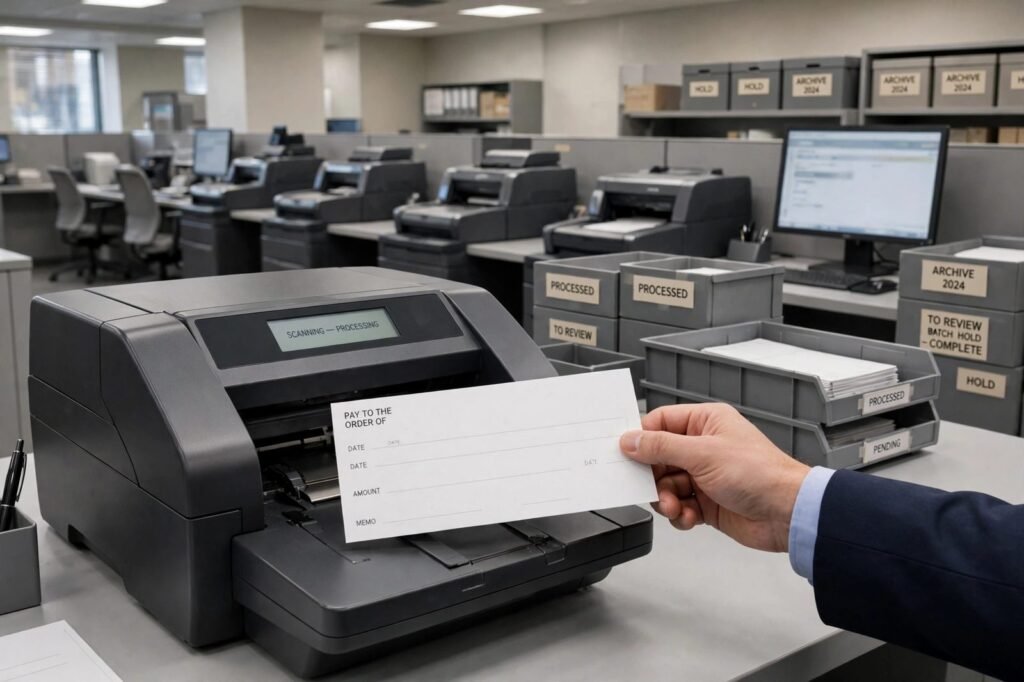
Once you have deposited a check, the bank will capture a picture from front and back together with the payment information, the routing number, account number, check number, and the amount from the MICR line. The image that comes from this point is not the paper. The cashier or app reads the MICR line, confirms approval in the back, logs the deposit against your account.
At this point, the bank practically has not researched whether a check was really good: it confirmed that the check existed, acknowledged and readable. Whether the account of the writer keeps the funds, whether there is a stop payment or whether the check is fraudulent, these questions will be for later stages.
The Clearing Journey: Your Bank, the Network, the Paying Bank
From your bank, the check image travels electronically to the paying bank via a clearing network or directly to the bank managing the writers’ account. The paying bank controls the account: is it available, has enough money, is there a stop payment on this control number, is the signature consistent? When everything’s done, the paying bank will debit the writer’s account and settle it with your bank.
Almost always, the check will be delivered to paying bank overnight when a check-in is checked in and debited from the checker account the next working day. This nocturnal speed is why most deposits appear to be in such a fast position, and why the exceptions feel so abrupt when they arrive.
Available Does Not Mean Verified
Here is the trap. Banks may deposit funds before verification is completed, and most often because customers expect quick access. But availability is a courtesy that is based on the risk judgement of the bank, not a guarantee that the cheque was released.
If paying bank returns your check later, insufficient money, stop payment, suspected fraud, your bank will refund your deposit, even if you have already spent it. This is what a “bounces after it clears” cheque looks like: He never really accepted; he just seemed clear.
Defense is the habit. It’s not a product. Take a deposit into your own accounts as awaiting, not to be issued until the available resources are confirmed and the return window passes. Keep tracking your spending which are marked with outstanding deposits as such will make your balance fair through just this window. For large or unknown checks, waiting for a few extra days before spending is the cheapest insurance available.
Why Holds Happen
Sometimes no funds are immediately made available by the bank, and it places a hold. Holds happen for reasons which are intentionally general: the account is new, the amount is large in relation to the account history, the verification is from an unknown source, or the bank has reason to doubt collecting. Before it extends an early admission, Delay isn’t a charge; it’s a bank buying time to verify.
The bank must tell you that there is a holding in place and when the money will be available. You can specifically request that date if it is not voluntary. For each asset there is no universal dollar threshold. Thresholds and timelines vary depending on the bank, account, and check type, so treat any given number that you make online as a claim to verification with your own bank, not a rule.
Check 21 and Substitute Checks
The reason for traveling images instead of paper is a law called Check 21, signed in October 2003 and with effect from October 2004. Prior to it, banks physically send out paper checks through the country; thereafter, a bank may take a picture of the front and back of a check and send that image electronically instead of moving the paper. Replacement which was based on image is called a replacement, which is the legal equivalent of an initial check, provided that it accurately reflects the information on the original and represents a statement that it is a legitimate copy, which can be used the same way as the original.
There are two consequences which are important to ordinary account holders. Firstly, Check 21 did not amend the maximum waiting times that are established by the law on availability of funds. The image speed did not rewrite the availability rules. Secondly, banks are not required to maintain your initial paper checking for a certain length of time. In many cases the original will be destroyed after imaging.
If you need a copy of a deposited check, ask your bank to get the image or replacement check. The paper original may not exist anymore. The Federal Reserve’s own FAQ is the brightest source for all this: see the Federal Reserve’s Check 21 FAQ for the dates of the law, the substitute control definition, and the hold-time point in the regulator’s own words.
What Makes a Check Bounce After Deposit
Almost all the reversals relate to three causes. Lack of funds: The writer did not have sufficient funds when the bank of payment was reviewed. Stop payment: the writer ordered their bank not to pay this check number, usually because it had lost the check or the deal behind it had failed.
Suspect fraud: check appears to have been modified, fake, or some of a known scam pattern. Your bank will withdraw the deposit and inform you in all three instances. If you already spent the money this reversal might overflow your account.
If the bounced check was one that you wrote, instead of one that you’ve received, the Follow branch continued: a bounced payment to a lender counts as a missed payment, with fees and credit consequences of its own. Please visit our guide to a missed loan payment for next steps in such case. If the bounced check is one you received, contact the author immediately: You may not know that your account was short, and a replacement payment by a method that resolves immediately is the common solution. And whatever you do, do not pay back the same check hoping to get another result; a returned cheque that will be refunded unchanged will usually be returned.
Frequently Asked Questions
How do banks verify checks?
By looking at the check, sending the electronic cheque to the paying bank, and allowing that bank to verify the balance, status of the stop payment and signature. Verification is completed after settlement, not after deposit.
How long it take to clear your check?
The picture usually reaches the paying bank at night and is debited the next business day, but final settlement, the point after which reversal becomes unlikely, may take longer. Your bank’s availability schedule will deal with what you can spend in the meantime.
Why’s my check on the hold?
Usually, a new account, big quantity, unknown source, or doubt about collection. A hold is the bank that checked before it releases funds, not a judge on you.
Can you bounce a check when it’s gone?
The check, which was only cleared, could still be reversed for funds indicated before it was finalized. True final settlement rarely turns back so it’s wise to wait before large or unknown deposits are spent.
What’s Check 21 and the replacement check?
Verification 21 is an act under which banks can transfer control images electronically rather than via shipping documents. A replacement check is the image-based legal equivalent of the original, which can be used in the same manner.
This Article is intended only for education purposes and is not a financial recommendation. When a deposit is suddenly returned, contact the bank to quickly see why and what options.