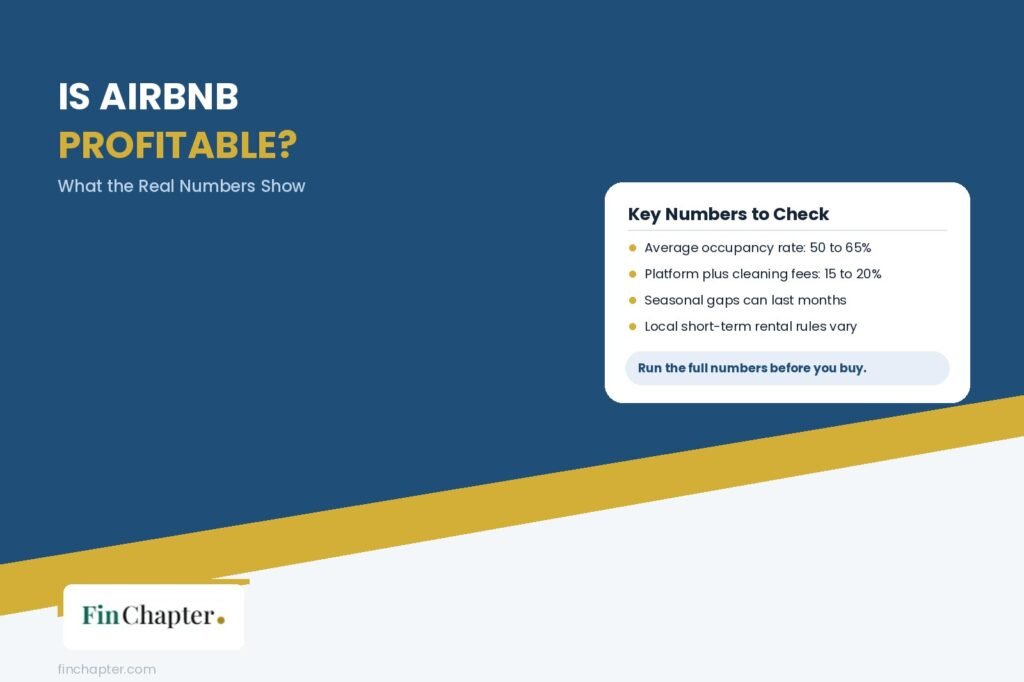
While Airbnb can be profitable, a full calendar doesn’t equal a good profit. It’s not about the monthly sales. It is the money which is still left after platform fees, cleaning, utilities, repairs, taxes, insurance, financing, and your time. Determine break-even occupancy prior to purchasing furnishings or posting a listing.
Airbnb Profitability Starts With Break-Even Occupancy
The break-even occupancy is the number of nights you need to fill in order to break even. It reveals bad deals that appear to be worth while because they are only presenting their nightly rates and gross revenue.
Suppose the $2,300 is the amount of the monthly fixed costs of a property, which consists of the mortgage, property tax, insurance, internet, maintenance reserve, and licences. At $135 per night once you subtract the fees for the platforms, the cleaning, and the supplies, it takes approximately 18 nights to make any money back. This equates to about a 60% fill rate for a 30 day month.
The loss to the property is approximately $410 after 14 nights. It will cost approximately $670 before income tax and major repairs at 22 nights. Use conservative numbers, not the greatest price you saw on the day of the festival or the day after the holidays.
Don’t confuse Gross Booking Revenue with Profit
Gross booking revenues are defined as the net rate x the number of nights booked plus any revenues you earn from the night. Net operating profit is the profit after property-level expenses. This is what causes new hosts to overestimate the profit on their vacation rentals.
If you charge $185 per night and reserve for 16 nights, how much will your total charge be? The gross room revenue is $2,960. With the assumption of 15% host platform fee, the fee would be $444. Include $520 for turnovers, $260 for utilities and internet, $200 for supplies and repairs, $1,100 for financing and $350 for property tax and insurance. The total is $2,874 with $86 left before income tax.
Gross revenue will increase to $3,700 after 20 nights booked. If the total cost is $3,115, then monthly profit is $585. Most of the profit is generated during the four additional nights due to the fact that a number of the ownership costs remain constant.
The platform fee will soon be a bigger topic of discussion
In an annual report for 2025, Airbnb revealed that it started implementing the one-fee model, where the service fee is borne by the host instead of being split between host and guest, in October 2025. The older split fee model was still used for some bookings between the transition.
That change is important as it could mean a bigger loss from the booking subtotal for a host. Never use an old calculator that calculates host fee without verifying the correct fee one can see in your account. A 3% fee on $4,000 of bookings is $120, while a 15% fee is $600. The $480 gap could wipe out the anticipated profit on a financed home.
Make an accurate prediction based on the price that you believe you will be paid, not the price that the guest will be paying. Examine cancellation adjustments, taxes, discounts and co-host fees separately.
Occupancy Rate Does Not Tell the Whole Story is the topic of our discussion
The occupancy rate is a number that is calculated by dividing the number of nights booked by the number of nights available, but it is not an indicator of the amount of money that was paid. A property booked 75% of a 30-day month at $100 per night produces $2,250. A competing property is fully booked at 55% at $160 and generates $2,640.A competing property full-booked at 55% at $160 generates $2,640.
Revenue per available night combines all of the variables of price and occupancy. Property #1 has $75 available per night, and property #2 has $88 available per night.
Increased use could lead to additional cleaning, laundry, wear and replacement expenses. Four five night stays can give you the same amount of time booked as ten two night stays, plus six additional turnovers. The overheads at $85 per turnover would be an additional $510. Don’t establish minimum stay requirements, based on whether or not every weekend is sold out, but rather on net income.
Expenses Hosts are the ones who forget to add the cost of their trip
There are pretty obvious costs such as the mortgage, property tax, insurance, cleanings, utilities and platform charges. There are a lot of costs that are overlooked, like furniture replacement, loss of linens, pest, lawn maintenance, permits, accounting, refunds, vacancy, and emergency repairs.
The furnishing package for the 4 years is approximately $12,000, and costs approximately $250 per month before replacement. When you figure out that the cost of air conditioning failure is $6000, spread over 5 years, it is $100 per month. Subtract $4,000 x 5% repair reserve for a monthly revenue figure, and then add an additional $200 in the property account should remain.
Owners who hire out include the property management fees, which may be a percentage of revenue or be charged separately as a service charge. An emergency fund for the home decreases the risk of a cancellation wave or plumbing repair appearing on a credit card.
Taxes have the ability to alter the outcome you obtain
Rental Property Expenses may include mortgage interest, real estate taxes, maintenance, utilities, insurance and depreciation, says the IRS. These deductions can be used to lower the taxable rental income, but they will depend on personal-use, passive-loss and depreciation rules analysis.
In the general rules of reporting rental activity, rental income is reported on Schedule E; however, if the rental owner also provides the guest with extensive services primarily for the convenience of the guest, the income may be reported on Schedule C. That distinction may impact self-employment tax.
Now assume that a property generates a cash profit of $9,000 annually before any tax deductions, with $7,000 of tax depreciation allowances. Cash profit may be greater than taxable because of the owner’s situation. The opposite could also be true since loan principal repayment makes cash flow a negative while the payment is not deductible. Make sure to have a professional tax preparer prepare the first year return.
The majority of the return comes from buying the Property Well
There is no cure for an overbought price, other than a strong operator. Calculate short-term rental income and compare this with short-term rental profit; then compare with total cash requirements of the property.
Assume a home costs $300,000 and requires a $60,000 down payment, $9,000 in closing costs, and $15,000 for furnishing. The cost of your up-front cash investment is $84,000. The cash-on-cash return is 10% on this property if the net income after expenses, before tax, is $8,400 a year. The return is 5% if annual profit is reduced to $4,200 due to weaker demand.
Each choice of the house rental vs buying a home is different from the choice between a house rental vs owning a business. Test out higher rates, lower occupancy, and higher repair costs with the help of a mortgage calculator. If it’s only having a 80% occupancy rate and charging high prices for peak seasons, there is really no margin for safety.
The Bottom Line
The Airbnb business is profitable if the actual net revenue is greater than all operating expenses, and the return on the Airbnb’s cash investment is still sufficient. Determine the break-even occupancy, run a weak-season scenario, validate local rules and check pricing management time prior to purchase or conversion of a property. Make a comparison with a long-term rental and a lower-effort investment. Only proceed if it continues to be a good deal with fewer reservations, lower prices, and a repair reserve.
Frequently Asked Questions
Will Airbnb make money in 2026?
Yes, but only if it is profitable which is dependent on the purchase price, local demand, platform fees, regulations, financing, and operating expenses. A property which can stay profitable at a occupancy rate below the expected is safer than one that requires a very high occupancy rate.
What’s a good profit margin for Airbnb?
The ideal target will differ depending on the type of investment property, as it can be financed, owner managed or be rented as a luxury property all with differing costs. Determine the net operating profit as a percentage of the gross booking revenue and make comparison with investments of comparable risk.
How many days in the month does an Airbnb have to be rented for it to be profitable?
Calculate the monthly fixed costs per contribution earned per occupied night. With fixed costs at $2300 and the contribution margin per night being $135, the property should break even on about 18 nights per month.
Discamiler:
This article is for general informational purposes only and does not constitute financial advice. Please consult a qualified financial adviser for guidance specific to your situation.