
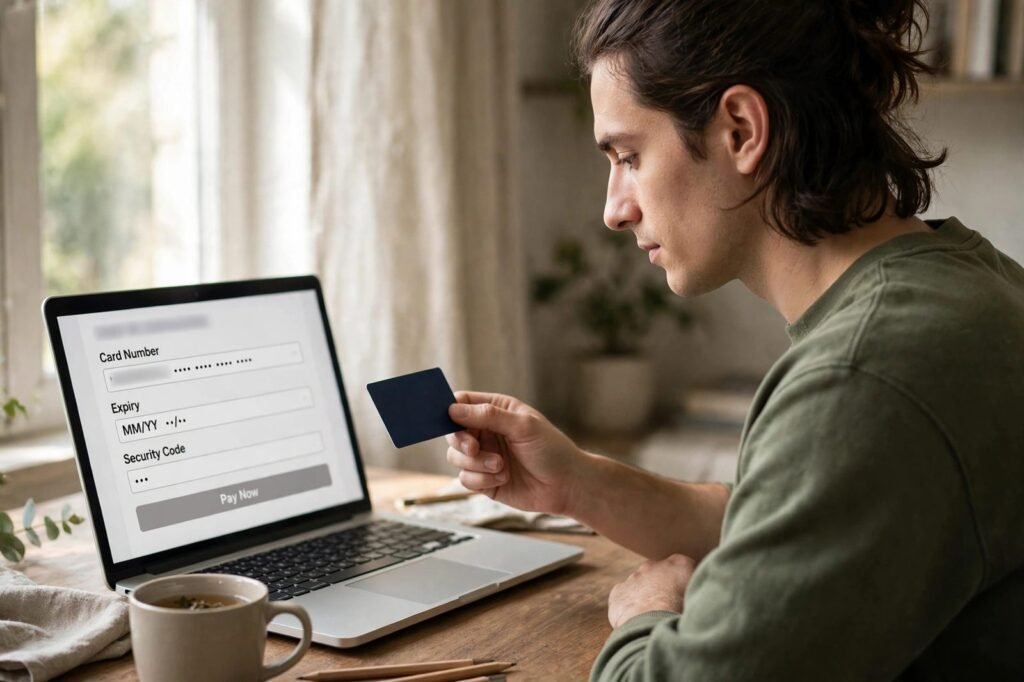
You are at an online checkout, and the form asks for a CVV2. You flip the card over, find the small digits, type them in, and move on. Most people never stop to ask what those digits are for, or why the same form never asks for them when a subscription renews. CVV2 Meaning is simple on the surface and strict underneath: it is the code that proves you hold the card, and it is a code that nobody is allowed to keep.
That second half is the part that protects you: the code exists only for card-not-present payments, the issuer checks it, and the merchant must delete it after authorization.
CVV2 Meaning: The Printed Code, Not the Stripe Value
A card security code is the three- or four-digit number printed on a credit or debit card that helps verify the holder physically has the card during online or phone purchases. It is separate from the card number printed on the front, and it serves as a second layer of proof that the person entering card details is the actual cardholder.
The “2” in CVV2 matters. It distinguishes the printed code from a separate value encoded in the card’s magnetic stripe that the holder never sees. Regardless of which label a checkout page uses, whether CVV, CVC, or security code, you enter the digits printed on your specific card. This article prints no real code in any example, and you should never share yours in a message, email, or form you did not initiate.
The Names by Network
Each network names the same idea differently. Visa calls it Card Verification Value 2, or CVV2. Mastercard calls it Card Validation Code 2, or CVC2. American Express and Discover call it Card Identification Digits, or CID.
The underlying job is identical across networks: prove possession at the time of a card-not-present order.
Knowing the names helps when a checkout label does not match your card. A page that says CVV and a card that says CID are asking for the same digits. What changes is where those digits sit, not what they do.
Where to Find It
On Visa, Mastercard, and Discover cards, the code is a three-digit number printed on the back of the card near the signature panel, usually at the end of the card number or standing alone to the right of it. It is printed in flat ink rather than the raised lettering used for the main card number, so it can be harder to read on a well-used card.
American Express uses a four-digit code printed on the front of the card, above the account number on either the left or right side. Entering a three-digit code from the back of an Amex card will cause the transaction to fail. If the digits become scratched or faded so they can no longer be read, contact your card issuer and request a replacement.
How the Check Works
When you type the code into an online checkout, the merchant sends it along with the card number, expiration date, and transaction amount to their payment processor, which routes the information through the card network to the bank that issued the card. The issuing bank checks whether the code matches what it has on file. A match sends back an approval. A wrong code returns a decline that processors label a CVV2 Mismatch error.
The entire exchange takes a few seconds.
Because the security code is not embedded in the magnetic stripe or stored by merchants after approval, a thief who steals only a card number from a database still lacks the code needed to complete online purchases.
When the Code Is Never Asked
The code exists solely for card-not-present situations like online checkouts and phone orders. Visa’s rules specifically prohibit merchants from requesting the security code during a card-present transaction, whether the card is swiped, tapped, or inserted at a physical terminal, and merchants also may not ask you to write the code on any paper form such as a receipt or order slip.
The same logic explains subscriptions. Merchants may keep the card number and expiration date on file for recurring billing, but the security code must be deleted from system memory immediately after the first authorization goes through, and subsequent recurring charges are processed without it.
The Storage Ban
The Payment Card Industry Data Security Standard, currently version 4.0.1, flatly prohibits any merchant or payment processor from storing the security code after a transaction is authorized, even in encrypted form, regardless of the reason and regardless of whether the merchant also stores the card number. The PCI Security Standards Council’s own FAQ confirms the rule under Requirement 3.2: these values are sensitive authentication data, they must not be stored after authorization, and the requirement cannot be met by cryptographic techniques.
The ban holds even with your permission. Requirement 3.2 applies regardless of any permission the entity may have received from the customer to store the data on their behalf. A customer’s request or approval to retain the codes has no validity for PCI DSS and does not constitute an allowance to store them. Only issuers or those providing issuing services may have a legitimate business need to store sensitive authentication data after an authorization.
Enforcement runs through the card networks and the merchant’s acquiring bank. Businesses that fail to comply face monthly fines from the card brands and, in severe cases, losing the ability to accept card payments entirely. This guide to card security codes, rules, and liability is the source for the location, liability, and storage rules in this article.
If Someone Uses Your Card
Under the Truth in Lending Act, liability for unauthorized credit card charges can never exceed 50 dollars, and only if the issuer has met several conditions including giving notice of the liability cap and providing a way to report lost or stolen cards. Once the issuer is notified, you owe nothing for any charges made after that point. In practice, most major issuers voluntarily offer zero-liability policies going beyond this statutory floor.
Debit card protections under the Electronic Fund Transfer Act are less generous and depend on reporting speed. Within two business days of learning about the loss or theft, liability is capped at 50 dollars. More than two business days but within 60 days of receiving the statement, liability can reach 500 dollars. After 60 days from the statement date, you face potentially unlimited liability for unauthorized transfers occurring after that window.
The clock starts when you learn of the loss, not when the fraud happened.
Beyond the Printed Code
When a card is added to a digital wallet, the card issuer creates a device-specific token, a substitute card number, along with a unique key generating a brand-new security code for every single transaction, so the real card number and printed security code are never transmitted to the merchant.
Some banks have piloted cards with an e-ink screen that refreshes the code every 30 to 60 seconds, but these are not yet widely available in the United States. Many issuers also let you generate a virtual card number for a single purchase or limited period, so the real details stay hidden and a compromised virtual number cannot be reused. Availability of virtual numbers and e-ink cards varies by issuer, and this article names no issuer-specific feature as generally available.
If Your Code Is Compromised
Act in this order. Contact your card issuer immediately, using the number on the back of the card or the bank’s app, report the fraud, and ask for the card to be blocked and a replacement issued. Place a fraud alert on your credit reports by contacting any one of the three major bureaus, Equifax, Experian, or TransUnion, which notifies the other two. A fraud alert lasts one year and makes it harder for someone to open new accounts in your name.
File a report with the FTC at IdentityTheft.gov to create a recovery plan, and file a local police report, which can help dispute fraudulent charges and may be required by your bank or a creditor.
Frequently Asked Questions
What does CVV2 mean?
Card Verification Value 2: the printed code on your card that proves you physically hold it during an online or phone purchase.
Where is the CVV2 on my card?
Three digits on the back near the signature panel for Visa, Mastercard, and Discover. Four digits on the front above the account number for American Express.
Why does checkout ask for CVV2 but my subscription does not?
The code is for the first card-not-present authorization. After that, the merchant must delete it, and recurring charges run without it.
Can a merchant store my CVV2 after I pay?
No. PCI DSS Requirement 3.2 prohibits storage after authorization, even encrypted, even with your permission. Only issuers or issuing-service providers may have a legitimate need to store it.
What happens if someone steals my card number and CVV2?
They can attempt online purchases, which is why you report immediately. Credit liability caps at 50 dollars by law and is usually zero in practice. Debit liability depends on how fast you report: 50 dollars within two business days of learning of the loss, up to 500 dollars within 60 days of the statement, potentially unlimited after that.
This article is for educational purposes only and is not financial or legal advice. Card network rules and liability protections depend on your card type, issuer, and jurisdiction, so contact your issuer immediately about any unauthorized use.